
Skip to content

How I work

An engagement that ends in one thing, written down.

The premise of this practice is that one written artifact, read by the right people, is more useful than a deck. Every engagement converges on a single document — a paper, an architecture, a harness, an obligations map, a letter — that can be picked up, read once, and acted on. The methodology below is what it takes to produce that.

The shape of an engagement is the same regardless of audience: builders, incumbents, regulators. What changes is the artifact and the depth of the supervisory framing. A builder receives a working architecture and an evaluation harness; an incumbent receives a strategic landscape paper or a vendor dossier; a regulator or institution receives a working paper or a comment letter, fully cited, designed to live in a footnote of someone else’s working paper a year later.

Senior buyers — bank strategy, CIO offices, central-bank research staff, registered PMs and IFMs, exchange policy teams, and the technical principals at the firms standing up agentic execution — read tight, written work faster than any other format. The work is built for that reader.
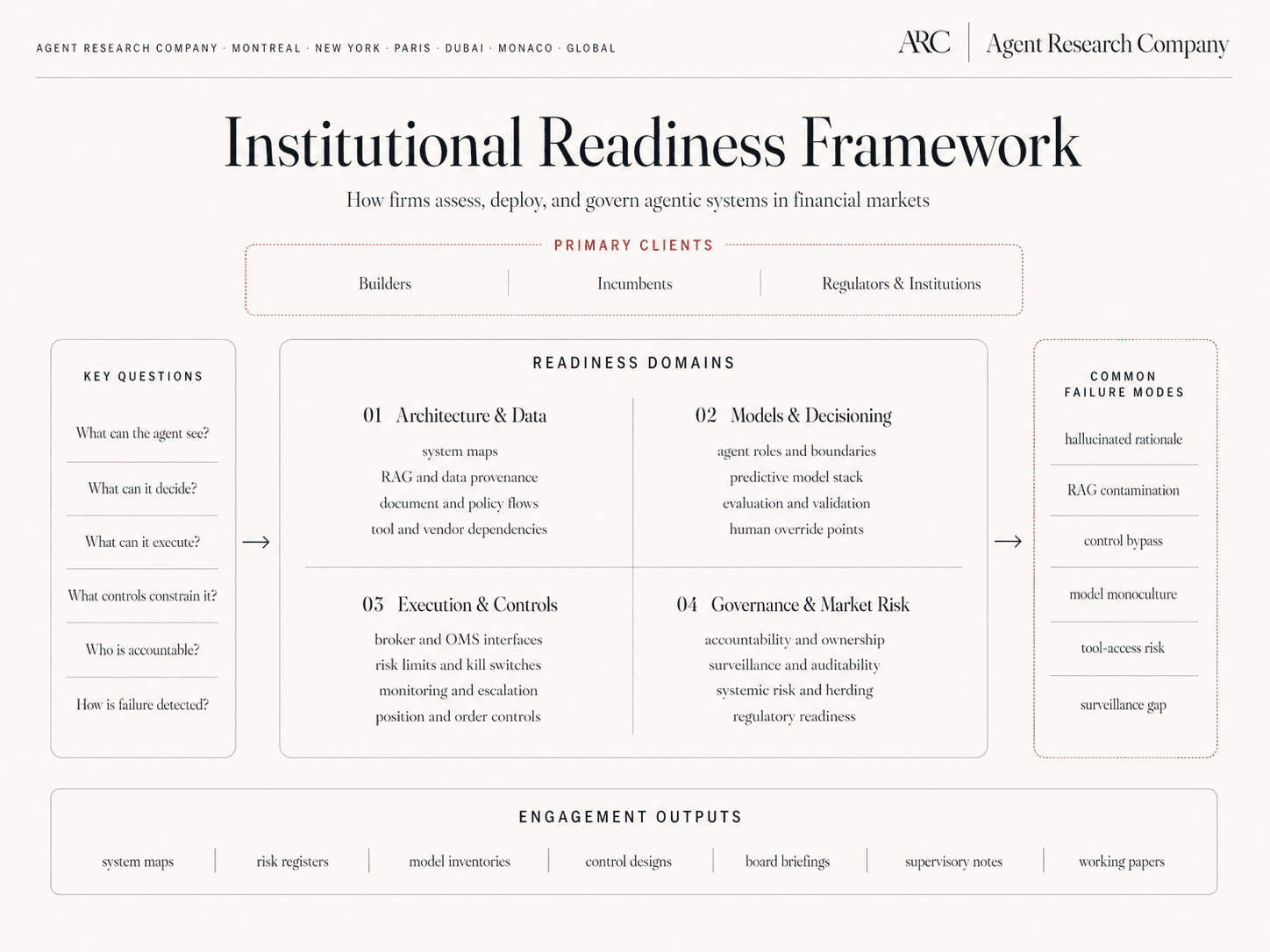
Institutional Readiness Framework — primary clients (Builders, Incumbents, Regulators and Institutions); four readiness domains (Architecture and Data, Models and Decisioning, Execution and Controls, Governance and Market Risk); engagement outputs spanning system maps, risk registers, model inventories, board briefings, supervisory notes, and working papers.
Institutional Readiness Framework — how an engagement maps the firm's clients, readiness domains, and outputs onto a single working surface.

  1. 01

    Frame

    An engagement opens with a focused reading sprint — the regulator filings, the codebase, the internal memo, the consultation draft, the market-data inventory. The output of this step is not a deliverable; it is the question that the engagement is actually being asked. Most engagements are scoped against the wrong question on day one. The Frame step is where we agree on the right one in writing, and where I will tell you, candidly, if the question is one I cannot usefully answer or one that another practitioner is better placed to take.

  2. 02

    Build the artifact

    One artifact per engagement. A working paper, an architecture, an evaluation harness, a regulator obligations map, or a comment letter — named in the brief, scoped during Frame, and produced in writing. Working notes during the build are visible: a shared folder, plain text, no client portal. The artifact is what you are paying for; everything else is overhead. The discipline of producing one written thing forces the analysis to converge.

  3. 03

    Hand it off

    Hand-off is a meeting, not a link to a document. The artifact is walked through with the people who need to act on it; questions surface in the room. Six weeks of follow-up Q&A is included in every engagement — for the questions that arrive after the meeting, when the artifact has been read by people who were not there.

What working with me looks like

Cadence
Async by default; one or two scheduled calls per engagement.
Hours
America/Montreal core; available for critical-path conversations across timezones.
Confidentiality
Standard NDA on request; published work omits client identity unless explicitly authorized.
Tooling
Plain text, PDFs, and a single shared folder. No client portal.
Conflicts
See policy below.
Independence
Structural — the practice does not accept paid endorsements, vendor commissions, or outcome-contingent fees.

Conflicts and independence

I do not take engagements where the analysis is pre-determined. Specifically: I do not write paid endorsements of agentic frameworks or vendor products; I do not produce comment letters whose conclusion is contracted in advance; and I do not produce strategic-landscape analyses that depend on omitting a competitor the firm finds inconvenient. Vendor due-diligence work is paid by the buyer, never by the vendor.

I will disclose, at scoping, any prior or concurrent engagement that bears materially on a new request. Where a conflict cannot be cleared, I will decline and refer.

Where a regulator-licensed opinion is required — registration positioning, formal interpretive request, marketing review, or representation before a regulator — I will say so and refer to outside counsel. The practice produces written analysis that equips counsel and compliance to do their work; it does not substitute for either.


Begin a conversation