
Skip to content

Build · Featured engagement

Building an Agentic Hedge Fund.

Standing up a hedge-fund-shaped agentic stack — analyst trinity, risk conservation, market-data, execution, research, and compliance — as an institutional proxy that supervisors, counterparties, and capital allocators recognise.

The agentic hedge fund is no longer a thought experiment. Multi-strategy funds are operating with single analyst desks supervising fleets of agents that perform research, risk, and execution work that previously required hundreds of headcount. At least one well-known fund operates with no human analysts at all. The architectural pattern is consistent: a small number of named agent roles, mapped one-to-one onto the named functions of a traditional investment firm, with hard supervisory boundaries between layers.

This page describes that pattern as an engagement. It is a written, named build of the role topology, the authorization granularity between agents, the decision-log schema, and the supervisory artifacts that an institutional proxy will be evaluated against in the next 12–24 months. It is the engagement most useful to firms that have decided to build but have not yet committed architecturally.
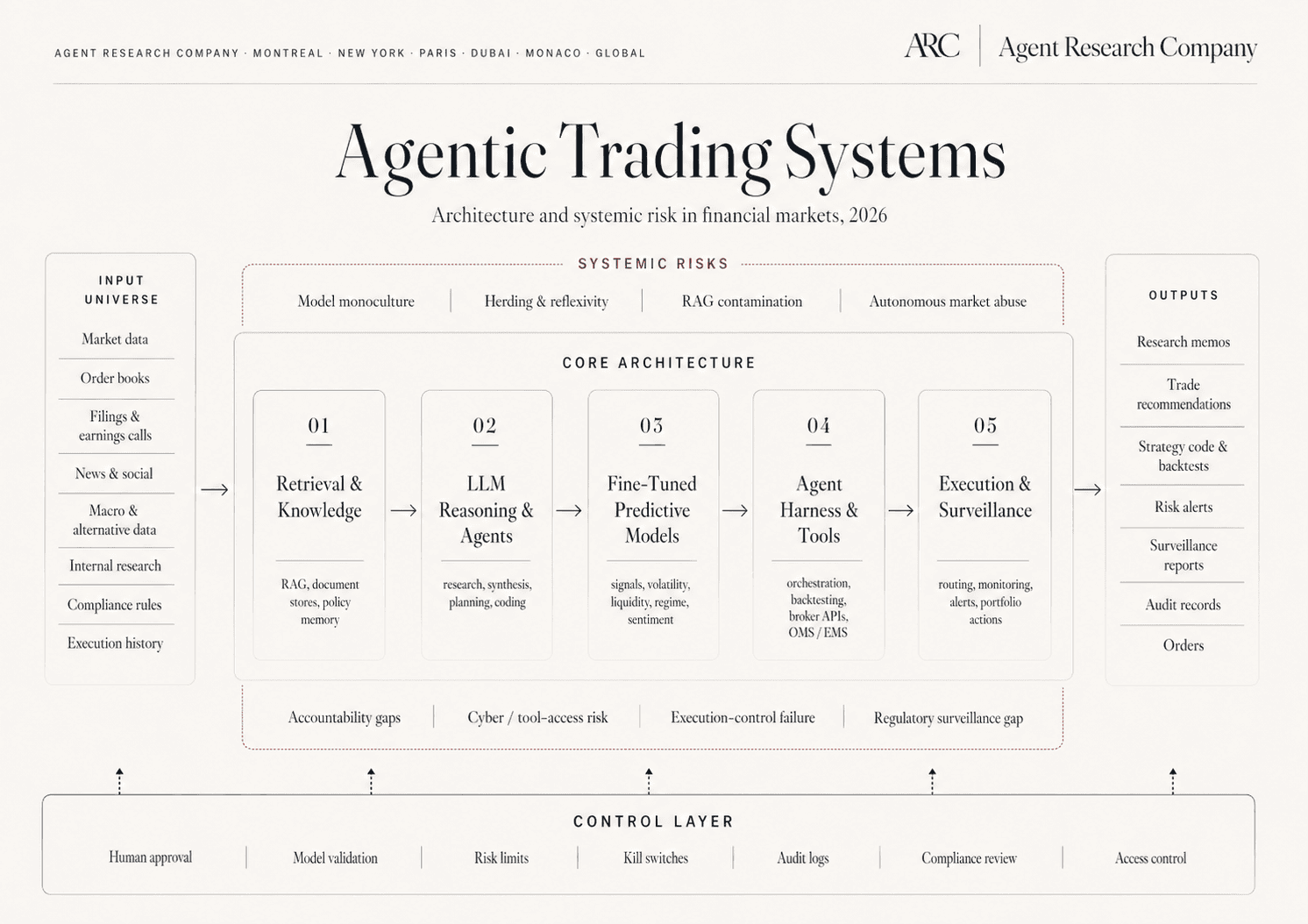
Agentic Trading Systems — architecture and systemic risk in financial markets, 2026.
The architecture this engagement builds against — analyst layer, risk conservation, MCP-mediated data and tool surface, execution, and the control layer underneath.

Agent roles · 09

The named roles inside an institutional proxy.

Nine roles. Each one maps to a named function inside a traditional investment firm. The shape is intentional — it lets counterparties, regulators, and the firm’s own internal audit function read the agentic stack without translating from software-architecture into investment-management language.

  1. 01

    Sentiment Analyst Agent

    Reads news, filings, transcripts, and social signals; produces a directional read with a citation chain back to source text.

    Sentiment agents convert unstructured text into a structured directional read. They consume regulator filings, earnings transcripts, news wires, social-media posts, and broker research — and emit a typed output: bullish / bearish / neutral, with a confidence interval and the spans of source text that drove the conclusion.

    The defensible Sentiment agent is the one whose output is auditable. Every directional call carries a citation chain a human can re-read. Every confidence number is calibrated against historical precision on the same source class. The Sentiment agent that produces a number without a citation is a liability, not an analyst.

    Inputs

    • News wires (Bloomberg, Reuters, Dow Jones)
    • Earnings transcripts and management commentary
    • Regulator filings (10-K, 10-Q, 8-K, 6-K, equivalents)
    • Social-media and forum signal feeds
    • Sell-side research summaries

    Outputs

    • Typed directional reads with confidence interval
    • Citation chains to underlying text spans
    • Per-instrument sentiment time-series
    • Shift detectors when sentiment regime changes

    Tooling anchors

    Claude / GPT-5 / Gemini · FinBERT · FinGPT · RavenPack · AlphaSense

  2. 02

    Fundamentals Analyst Agent

    Parses financial statements, peer-comparable data, and supply-chain disclosures; produces a written valuation thesis with explicit assumptions.

    Fundamentals agents cover the work that a junior-to-mid-level equity analyst used to do at scale. They ingest filings and structured data, build comparable analyses, parse management commentary against prior-period guidance, and emit a written valuation memo with explicit, named assumptions.

    What changes with an agentic Fundamentals layer is not the quality of the per-name analysis but the breadth at which it can be sustained. A small team of senior analysts now supervises agents producing thesis-grade memos across hundreds of names per cycle. The senior’s value moves from coverage to question-formation and to disagreement with the agent’s output.

    Inputs

    • Audited financials and adjustments
    • Peer-comparable financials and ratios
    • Industry data (segment revenue, unit economics)
    • Supply-chain disclosures and supplier filings
    • Macro context — rates, FX, commodities

    Outputs

    • Written valuation memo with named assumptions
    • Sensitivity tables (revenue, margin, multiple)
    • Comparable-set construction with rationale
    • Risk register specific to the name

    Tooling anchors

    Claude / GPT-5 · BloombergGPT · FactSet · FinGPT · OpenBB

  3. 03

    Quantitative Analyst Agent

    Applies statistical and ML models to time-series data, factor exposures, and cross-asset relationships; produces numerical forecasts with confidence bands.

    Quant agents convert market-data and alternative-data feeds into numerical forecasts. They run factor-model fits, time-series foundation-model inferences, and regime-detection on cross-asset data. They emit forecasts with documented confidence bands, the model version that produced them, and the data window the forecast was conditioned on.

    The supervisory weight of the Quant agent sits in two places: the model card (what model, what version, what training data, what known failure modes) and the forecast log (what forecast was made, when, against what input). Both are documentary commitments before they are technical artifacts.

    Inputs

    • Market-data feeds (tick, bar, order-book)
    • Factor data (Fama-French and proprietary)
    • Macro time-series (rates, FX, commodities, vol surfaces)
    • Alternative data (satellite, transactional, web-scraped)

    Outputs

    • Numerical forecasts with documented confidence bands
    • Regime classification with timestamps
    • Factor exposure decomposition
    • Model card and forecast log entries

    Tooling anchors

    TimeGPT · Chronos · Lag-Llama · Qlib · FinRL · QuantConnect / LEAN

  4. 04

    Risk Conservation Agent

    The hard supervisory layer above analyst agents — vetoes trades, enforces position-sizing rules, and conserves capital under stress regimes.

    The Risk Conservation agent is the hardest part of an agentic stack to build well and the most consequential to get wrong. It must have hard veto authority over the analyst layer, independent inputs that the analyst agents cannot influence, a separate decision log that records every exercise of that authority, and a clean override path for a human risk officer to dial down or pause the system without taking the rest of it offline.

    A defensible Risk Conservation agent is not a stop-loss script. It enforces position-sizing logic against volatility regimes, liquidity scoring, drawdown caps, factor-exposure limits, counterparty concentration, and venue concentration — and it does so against ex-ante written rules that compliance can read.

    A useful diagnostic question, in due diligence: show me the last five Risk-agent vetoes, in writing, with the analyst-agent reasoning that triggered each one. Firms whose Risk layer is real can produce that document quickly. Firms whose risk layer is a label cannot.

    Inputs

    • Position sizing inputs (volatility, liquidity, ADV)
    • Drawdown and exposure limits (firm-wide and per-mandate)
    • Counterparty and venue concentration metrics
    • Stress-test outputs from independent sources
    • External market-stress signals (VIX, credit spreads, funding rates)

    Outputs

    • Pre-trade vetoes with written justification
    • Position-size adjustments to analyst-agent proposals
    • Risk-event log entries with severity grading
    • Real-time exposure dashboards (for the human risk officer)

    Tooling anchors

    Independent eval harness · Decision-log schema · Custom risk libraries · QuantLib

  5. 05

    MCP Market-Data Feed Agent

    Acquires, normalizes, and serves market data through Model Context Protocol surfaces — the agent-grade replacement for human-readable terminals.

    Where the human analyst opened a Bloomberg terminal, the agentic stack opens an MCP connection. The MCP Market-Data Feed agent is the layer that sits between an institutional or programmatic data source (Bloomberg BPIPE, Refinitiv, Polygon, on-chain analytics) and the analyst, quant, and risk agents that consume it.

    Done well, this agent enforces licensing and entitlement at the boundary, records every data request with the upstream feed it served, and exposes a uniform query surface to downstream agents. Done badly, it becomes a single point of failure, a license-compliance liability, and a data-leak vector all at once. The supervisory expectation will land here within the next 18 months — agent-grade data licensing is an open question regulators are explicitly tracking.

    Inputs

    • Institutional terminal feeds (BPIPE, Refinitiv)
    • Market-data APIs (Polygon, Databento, Alpha Vantage)
    • On-chain analytics (Glassnode, Coin Metrics, Dune, Chainalysis)
    • Alternative data feeds (satellite, transactional, news/sentiment)

    Outputs

    • Uniform agent-readable query surface
    • Entitlement-checked data delivery to downstream agents
    • Per-request audit log with upstream feed and license context
    • Cached and rate-limited responses for cost control

    Tooling anchors

    MCP servers (custom and published) · Bloomberg BPIPE · Refinitiv · Polygon.io · Kaiko · Glassnode

  6. 06

    Social Sentiment Feed Agent

    A specialised feed for social-media, forum, and creator-economy signal — separated from generic sentiment because the failure modes are different.

    Social-sentiment is treated as a distinct layer because its failure modes are unlike news-and-filings sentiment. Bot manipulation, coordinated inauthentic behaviour, paid promotion, and short-vol-of-vol regime shifts in retail attention all live here. The Social Sentiment Feed agent normalises those signals, applies bot-detection and coordinated-behaviour classifiers, and emits a typed output that the upstream Sentiment Analyst agent can weight against more reliable signal classes.

    The well-supervised Social Sentiment agent records its bot-classification confidence per signal, separates author influence from author authenticity, and is itself adversarially red-teamed at a higher cadence than other feeds. It is the layer most exposed to deliberate manipulation and accordingly the layer with the most documented eval coverage.

    Inputs

    • Social platforms (X / Twitter, Reddit, Discord, Telegram)
    • Creator-economy and influencer signal
    • Forum threads and DMs (within ToS / consent)
    • Bot-detection model outputs
    • Coordinated-behaviour classifiers

    Outputs

    • Per-instrument retail-attention time-series
    • Bot-classified vs human-classified signal split
    • Coordinated-behaviour alerts with confidence
    • Manipulation-risk flags routed to compliance

    Tooling anchors

    FinBERT · Custom classifiers · Bot-detection models · MCP social-data servers

  7. 07

    Research Agent (long-horizon)

    Long-horizon synthesis across analyst outputs, working papers, and the firm’s own historical theses — the institutional-memory layer.

    The Research agent is the long-horizon counterpart to the analyst trinity. Where Sentiment, Fundamentals, and Quant agents produce per-name, per-cycle output, the Research agent ingests the firm’s own working papers, prior theses, post-mortems on closed positions, and the wider literature. It produces synthesis: where conviction has shifted across cycles, which assumptions have been revisited, which theses have been retired and why.

    This is the agent that gives an institutional proxy its institutional memory. Without it, an agentic firm forgets in cycles measured in months. With it, the firm remembers across cycles measured in years — which is the operational definition of an institution.

    Inputs

    • Firm working papers and theses (current and historical)
    • Post-mortem records on closed positions
    • External academic and industry literature
    • Regulatory filings and consultation responses (firm-authored)

    Outputs

    • Cross-cycle synthesis memos
    • Conviction-shift logs (where and why the firm changed its mind)
    • Retired-thesis register with reasons
    • Reading lists for incoming analyst cycles

    Tooling anchors

    LlamaIndex · Letta / Mem0 · pgvector · Anthropic Agent SDK

  8. 08

    Execution Agent

    Translates approved trades into orders against pre-authorized venues, with TCA-grade logging and a clean separation from the analyst layer.

    The Execution agent sits between the trade decision (analyst + risk approval) and the venue. It selects from a pre-approved venue list, chooses order type and timing within an envelope set by the firm, and writes a transaction-cost-analysis-grade record of every fill. It does not originate trades.

    The architectural decisions here are quiet but consequential. Whether the agent is permitted to discover venues at runtime, whether it can issue exotic order types, and whether its behaviour triggers a regulator’s definition of automated quoting or high-frequency trading — these are documentary commitments that compliance and external supervisors will read.

    Inputs

    • Approved trade with pre-trade risk sign-off
    • Pre-approved venue list and routing logic
    • Real-time market microstructure (depth, liquidity, latency)
    • TCA benchmarks (arrival price, VWAP, IS)

    Outputs

    • Routed orders with venue and order-type rationale
    • Per-fill TCA record
    • Slippage and market-impact reports
    • Venue-concentration metrics for the Risk agent

    Tooling anchors

    Interactive Brokers API · Alpaca · FIX 4.4 / 5.0 · Coinbase Prime · Hyperliquid

  9. 09

    Compliance and Audit Agent

    Produces regulator-grade narratives from the firm’s own decision logs — the layer that converts a stress event into a written response to a supervisor in hours, not weeks.

    The Compliance and Audit agent reads the firm’s own decision logs across analyst, risk, and execution layers, and produces written narratives a regulator or internal audit function can read. It is the answer to the question that arrives during a stress event: show us, in writing, what your system decided and why, in the four hours since the event began.

    Most firms in 2026 cannot produce that document in four hours. The Compliance and Audit agent is what closes the latency gap between stress-event onset and supervisory response. It is also the layer most likely to be required, in writing, by the next supervisory cycle.

    Inputs

    • Decision logs from analyst, risk, and execution agents
    • Regulatory taxonomy and obligations map
    • Firm policies and written supervisory procedures
    • External event triggers (volatility, halts, news)

    Outputs

    • Per-event written narrative for compliance review
    • Regulator-ready stress-event response packs
    • Internal audit reports on agent behaviour vs. policy
    • Gap-register entries when behaviour falls outside policy

    Tooling anchors

    Custom decision-log schema · LlamaIndex over policy corpus · Audit-trail signatures

Engagement

What this build looks like as an engagement.

A typical Building an Agentic Hedge Fund engagement is delivered as a Working Paper (F-01) or a Two-Week Sprint (F-02), depending on whether the firm needs the architectural artifact alone or wants a hands-on co-build of the topology. For firms operating institutional proxies on an ongoing basis, the work continues as a Quarterly Retainer (F-03) — quarterly review of the stack against the latest supervisory record, with monthly working notes and ad-hoc architecture reviews.

The deliverables are written. Architecture diagram, named role topology, authorization granularity matrix, decision-log schema, eval harness scaffold for the Risk agent, and a regulator-readable narrative explaining what the system does and does not do. Compliance and outside counsel can read the same artifact and act on it.

Where the firm already has a working agentic stack, the engagement is a review-and-rewrite — we read the existing topology, identify the documentation gap, and produce the artifact that closes it. Where the firm is at design stage, the engagement is a green-field build of the same artifact, scoped to the firm’s mandate and counterparty profile.


Begin

Send the question.

Schedule a 30-minute call See the full service list Frameworks and tools